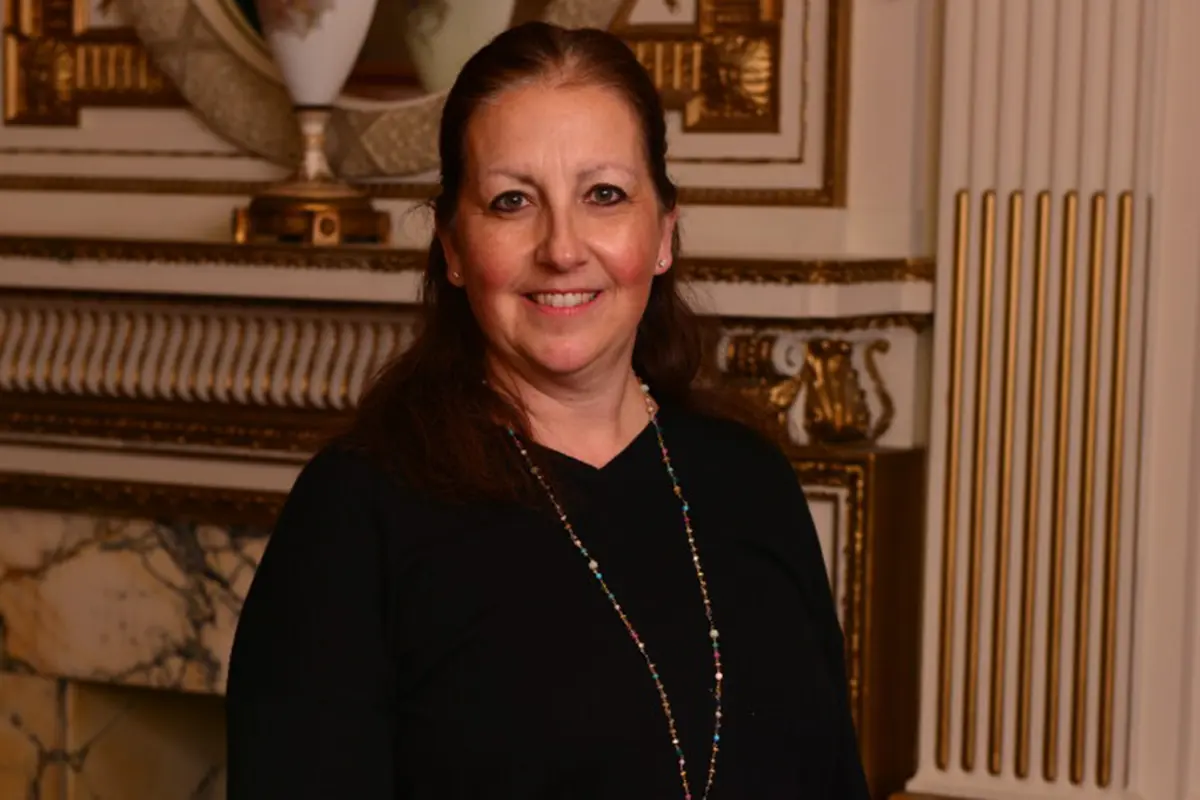
Dr. Stephanie Rahill, professor and director of the School Psychology graduate programs at Georgian Court University, is focused on practical ways school psychologists and educators can support students in real classroom settings. Her recent research and upcoming book explore how to better understand student needs and make informed decisions in schools.
A Practical Framework for Solving Classroom Challenges
In a newly published chapter, Instructional Consultation and Instructional Consultation Teams Research: Decade Review and Future Directions, co-authored with Dr. Lauren Kaiser, Dr. Rahill explores instructional consultation—a model that brings school psychologists and teachers together to address student challenges in real time.
The process is structured but flexible, guiding educators through identifying concerns, examining contributing factors, and developing targeted strategies. At its core is a strong working relationship between the school psychologist and the teacher.
“It centers on the relationships built throughout the process, creating a collaborative partnership between the consultant and the teacher to develop a thoughtful plan that supports a student who is struggling,” explained Dr. Rahill.
The chapter synthesizes a decade of research on this model while highlighting areas where further study is needed. For teachers, it provides ongoing support in navigating complex classroom situations, while for school psychologists, it offers a clear, collaborative framework that considers both the student and the broader classroom environment.
Preparing Graduate Students Through Case-Based Learning
Dr. Rahill’s upcoming book, Case Studies in School Psychology: Applying Standards for Professional Practice, 2nd edition, is designed as a hands-on training resource for graduate students preparing to enter the field.
The book uses real-world scenarios to help students work through situations they are likely to encounter in school settings. Each case includes guided questions that challenge students to think through their decisions and consider how they would respond in practice.
“In our field, things are not one size fits all,” Dr. Rahill said. “These are children in schools with complex issues.”
Rather than focusing only on theory, the case-based format encourages students to apply their knowledge, navigate uncertainty, and develop the critical thinking skills required in school psychology.
Improving Clarity and Usefulness in Psychological Reports
In another research article, co-authored with Dr. Heather Tacovsky, Assistant Professor of Psychology and Counseling, Dr. Rahill examines how school psychologists approach evaluation report writing. These reports help determine students’ eligibility for special education services and typically include cognitive, academic, and social-emotional information.
Dr. Rahill’s research highlights a consistent concern in the field: reports are often written using technical language and may not be easily understood by parents or teachers. “We write reports that a lot of times parents and teachers, and schools actually don’t find useful,” she explained. “They’re not parent-friendly and very technical with lots of jargon.”
As a result, key information may not be used as effectively to support students. Her work calls for reports that are more focused on the child and include clear, practical recommendations. “Parents are looking for help with their kids,” she said. “If they don’t understand it, then we’re not helping anyone.”
A Career Grounded in Practice and Student Transformation
Dr. Rahill brings nearly three decades of experience to her work in school psychology. She began her career as a school psychologist in 1998, working in Miami-Dade County Public Schools, Fairfax County Public Schools, and at an international school in Manila, Philippines, before joining Georgian Court 17 years ago.
At GCU, she leads a program that emphasizes hands-on learning, small cohorts, and close faculty mentorship. Because school psychology is a skills-based field, students develop their abilities through real-world application, feedback, and guided practice in school settings.
For Dr. Rahill, one of the most rewarding parts of her work is seeing that growth take place. By the end of the program, students are working in schools and contributing ideas based on their training and experience.
“You can see this transformation; they’re now professionals,” she said.