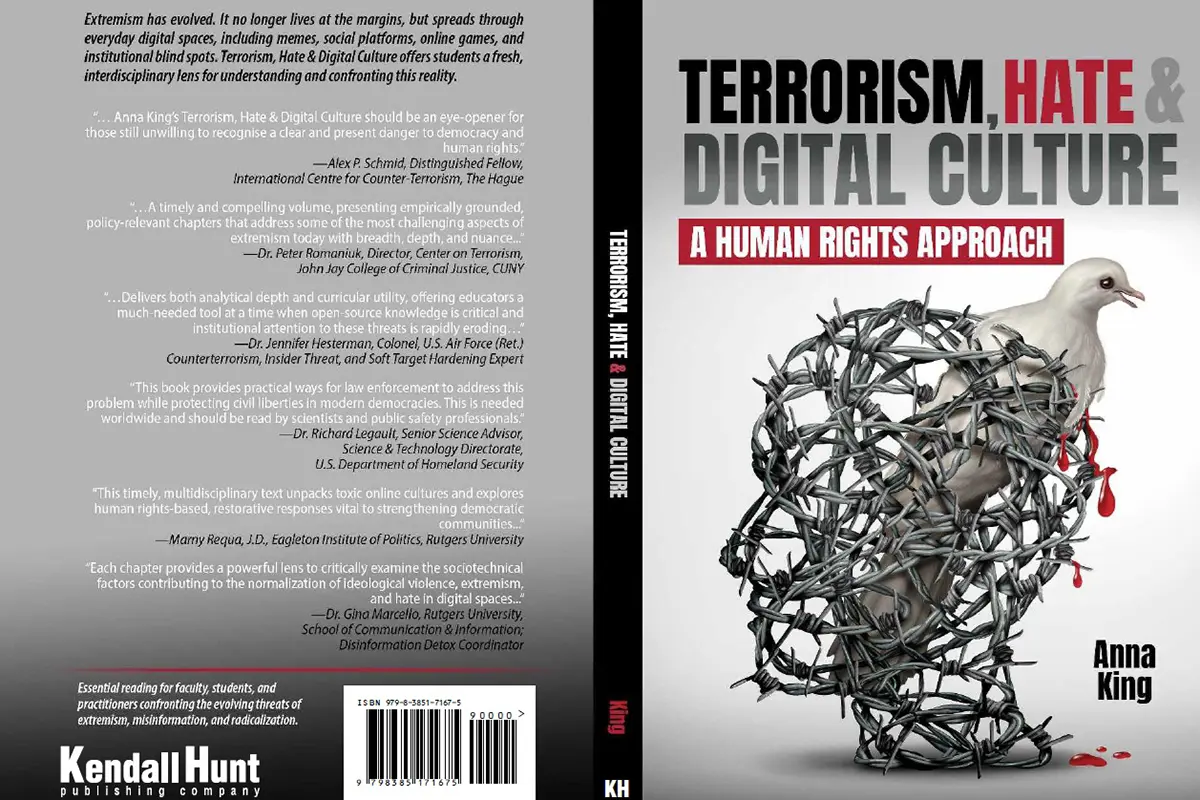
Dr. Anna King, Professor and Chair of the Department of Crime and Justice Studies, published her new book, Terrorism, Hate, Digital Culture: A Human Rights Approach, in September 2025. The book addresses 21st-century threats using a human rights framework, focusing on digital spaces, identity conflicts, and misinformation:

GCU: What’s your new book about?
Dr. King: My book examines how terrorism and hate have evolved in the digital age, and what that means for human rights, policing, and broader concerns about democracy. It features chapters that present original research related to the intersection of online culture, mental health, gaming, and public narratives.
GCU: Who’s the intended audience?
Dr. King: Students at broad-access universities are the core audience. The book has an international scope, with different chapters examining emerging issues outside the United States. For instance, one chapter examines a French political party’s response to a murder committed by an immigrant. Another examines how the introduction of Facebook in Myanmar sparked violence. Practitioners who work in environments such as policing, intelligence, threat assessment, online safety, digital culture, gaming, and those who focus on identity or gender-based harms may also find the book useful. The content seeks to bring to light different frameworks for dealing with emerging problems related to their work, not just in interactions with the public, but in how they think about their work, and in their interactions with one another.
GCU: What impact do you hope your book will have on readers, and how do you hope it will be utilized?
Dr. King: I want people to walk away with a better sense of how complex extremism really is, and to understand that it’s not something distant. Whenever these sorts of incidents happen, mass shootings, targeted violence, and political violence, our collective reaction is surprise, but these things are predictable and have a pattern. They do not come out of nowhere.
The idea was to put some potentially useful information, frameworks, and findings out there, so that readers would be better equipped to recognize patterns and come away thinking creatively about solutions.
GCU: What key points do you want readers to take away from your book?
Dr. King: The impact of digital culture is not a side issue; it is a central and pivotal “new” environment. Digital spaces require regular regulation, education, and community standards. We increasingly see this shift in policy abroad. Whether we will see it here remains to be seen. The digital environment, particularly in the US, for the most part, is accessible, affordable, and anonymous. It is largely unregulated. A media literacy platform can hold itself accountable to give people the tools they need to move away from those polarized narratives. Digital environments are experienced as real environments, and that impacts identity. Communities grow there, too. Mental health and meaning matter. Most people don’t wake up wanting to hurt others. They drift right towards harmful identities. There’s a relationship between the high levels of anxiety and loneliness, violence, and hate. What we see now is the normalization of many of these things.
If we put our energies more into the first areas of prevention, instead of counter-terrorism efforts, it might take longer and be messier, but ultimately it may get us to better, long-lasting outcomes.
GCU: How did the idea for this book come about, and why did you want to write it?
Dr. King: The book originated when I was searching for a textbook on domestic extremism. I realized there wasn’t a book that was accessible enough for the majority of college students. The market was also dominated by books that had 9/11 at the center.
Many of the textbooks treated domestic extremism as distant, foreign, and out of reach. There was a blind spot. So, the book was really me trying to close that gap and focus on updating students on terrorism post 9/11. The dynamics of terrorism and political violence are today much closer and woven into everyday life. Much of this is facilitated by the ubiquitous presence of digital environments. Digital culture deeply affects our mental health and our belief systems. Relying on outdated frameworks makes us vulnerable. For instance, today there is a gap in knowledge concerning democratic principles and human rights.
GCU: How has your criminal justice and psychology background, and experience teaching at Georgian Court, helped you write your book?
Dr. King: My background in criminal justice provides me with a good grounding in organizational systems, coercive behavior, legislative environments, and policy. My background in psychology is rooted in phenomenology and hermeneutics, so that is where I draw many of my methodological approaches from. For the book, I made it a point to ensure a balance between the data and human stories. I work with a wide range of emotions, including the emotional worlds in which people operate, and the cognitive shortcuts that shape their behavior.
My background enables me to view radicalization as a complex interplay of structure, identity, emotion, and opportunity. You can’t explain extremism and comprehend what’s happening without understanding individual grievances and mental health issues. Environment and structural conditions, which are not immediately visible, like norms and culture, also make a significant difference.
My students are very practical, and I appreciate the fresh perspective they have on these topics. They challenge me to keep whatever I’m doing useful and grounded in the current reality. I wrote the book with my students in mind, asking myself: how can this information be useful in the real world? I’m teaching the book for the first time in class, and it has been eye-opening for both my students and me to see how deeply their experiences are integrated with the online world.
GCU: Why should prospective students consider a Criminal Justice major or minor, and what’s special about GCU’s Department of Crime and Justice Studies?
Dr. King: Criminal justice is so multidisciplinary and valuable in a world that is getting smaller, metaphorically speaking. In this department, we have a diverse group of faculty members, including practitioner-scholars, scholars, and practitioners. We all work together and communicate effectively. The philosophy is that the job of criminal justice is a human one, not just a technical one. Students are educated on policing, courts, corrections, as well as the ethical and cultural dimensions behind the work.
We’re small enough to form one-on-one relationships with students, which is really important, but we’re also locally integrated, which creates opportunities, such as internships and trips. Our students have gone on to high-status positions within local, state, and federal governments, and have also earned law degrees, graduate degrees, or both. Current students benefit from alumni who often return to speak in our courses and create internship opportunities.
Our department is committed to addressing identity issues and the critical concerns of the Sisters of Mercy, while following the Mercy core values. Georgian Court has a special concern for women. Our program emphasizes equity and integrity in serving across all these fields, but we try to keep it down to earth and use common sense. It’s important to walk your talk, not just in person, but also online. We are a Catholic, mission-based institution, which emphasizes our commitment to service leadership.