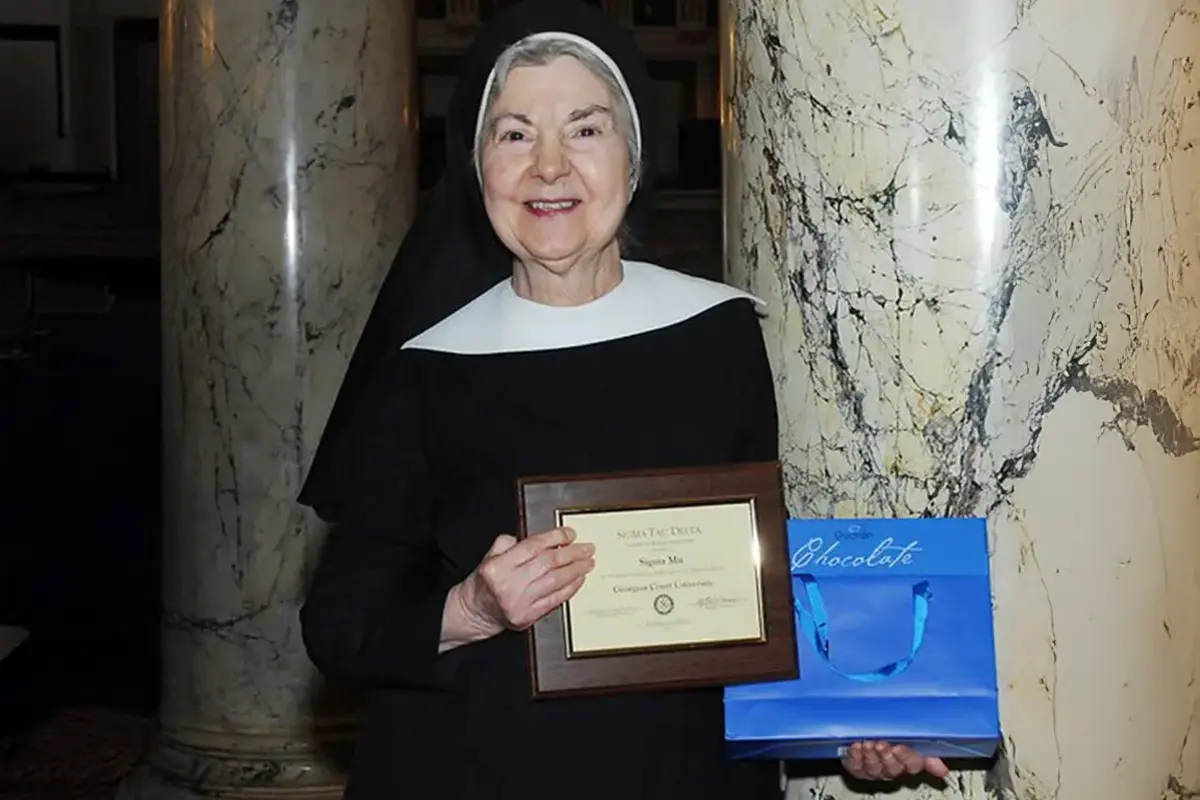
The Georgian Court University community mourns the passing of Sister Maria Cordis Richey, RSM, Ph.D. ’50, former university president, longtime professor of English, accomplished poet, and one of the most beloved educators in the institution’s history. Sister Maria Cordis entered eternal rest on June 6, 2026, at the age of 97.
For nearly six decades, Sister Maria Cordis helped define the academic and cultural life of Georgian Court through her leadership, scholarship, and commitment to students. Her influence extended across generations of alumni, faculty, staff, and Sisters of Mercy, leaving an impact that can still be felt across our university community.
“Sister Maria Cordis Richey’s impact on Georgian Court University is immeasurable,” said Eugene J. Cornacchia, Ph.D., Interim President of Georgian Court University. “As an educator, scholar, president, and Sister of Mercy, she inspired generations of students and strengthened the foundation upon which our university continues to build. Her love of learning, commitment to the humanities, and dedication to the Mercy mission continue to be reflected in Georgian Court’s values. We are profoundly grateful for her lifetime of service and the lasting influence she leaves behind.”
Born in Princeton, New Jersey, on March 16, 1929, Sister Maria Cordis attended St. Paul School and Mount Saint Mary Academy before enrolling at Georgian Court College, where she earned her undergraduate degree in 1950. That same year, she entered the Sisters of Mercy and would go on to earn both her master’s and doctoral degrees in medieval and Renaissance literature from Fordham University.
After teaching at St. Mary High School in Perth Amboy, Sister Maria Cordis joined the faculty of Georgian Court College in 1957, beginning a remarkable career of service to the institution. She served as professor and chair of the English Department and, in 1974, became the sixth president of Georgian Court College.
During her six-year presidency, Sister Maria Cordis guided the institution through a period of significant growth and innovation. Under her leadership, Georgian Court established its first master’s degree programs, expanded academic offerings, launched coeducational evening undergraduate programs, and approved several new majors.
Following her presidency, Sister Maria Cordis returned to the classroom, where she continued teaching and mentoring students for decades. Known for her deep knowledge of literature, her love of language, and her ability to inspire curiosity and reflection, she remained a cherished presence on campus until her retirement in 2011.
Beyond her work as an educator and administrator, Sister Maria Cordis was widely respected as a poet whose writings appeared in literary publications throughout the United States, Ireland, and New Zealand. She was also known for her passion for gardening, particularly her beloved roses, which became a familiar symbol of her appreciation for beauty, creativity, and contemplation.
In 2016, Georgian Court awarded Sister Maria Cordis an honorary Doctor of Letters degree in recognition of her extraordinary contributions to the university and the broader academic community.
Most recently, her legacy was celebrated through the establishment of the Sister Maria Cordis Richey Center for the Humanities and Creative Arts, which launched in 2024. Named in her honor, the Center serves as a vibrant hub for interdisciplinary learning, creative expression, undergraduate research, faculty collaboration, and community engagement.
The decision to name the Center after Sister Maria Cordis reflected her lifelong belief in the transformative power of the humanities and arts. As a scholar, teacher, poet, and mentor, she embodied the values the Center seeks to promote and preserve for future generations.
Today, the Center continues the work Sister Maria Cordis believed was essential to a thriving university community. Through its programs, events, research opportunities, and support for students and faculty, it fosters the intellectual curiosity, creativity, and human connection that she championed throughout her life.
The university will share information regarding memorial arrangements and opportunities to honor Sister Maria Cordis’s life and legacy as details become available.
As Georgian Court reflects on Sister Maria Cordis’s remarkable life, the university celebrates a woman whose impact cannot be measured solely by the positions she held or the programs she created, but by the generations of students she inspired, the colleagues she mentored, and the spirit of learning and compassion she brought to the community she loved.
Her legacy lives on—in classrooms, in scholarship, in poetry, in the humanities she championed, and in the countless lives she transformed.