For students in Georgian Court University’s Social Justice Ethics course, learning about social justice during the spring 2026 semester extended beyond the classroom and across national borders.
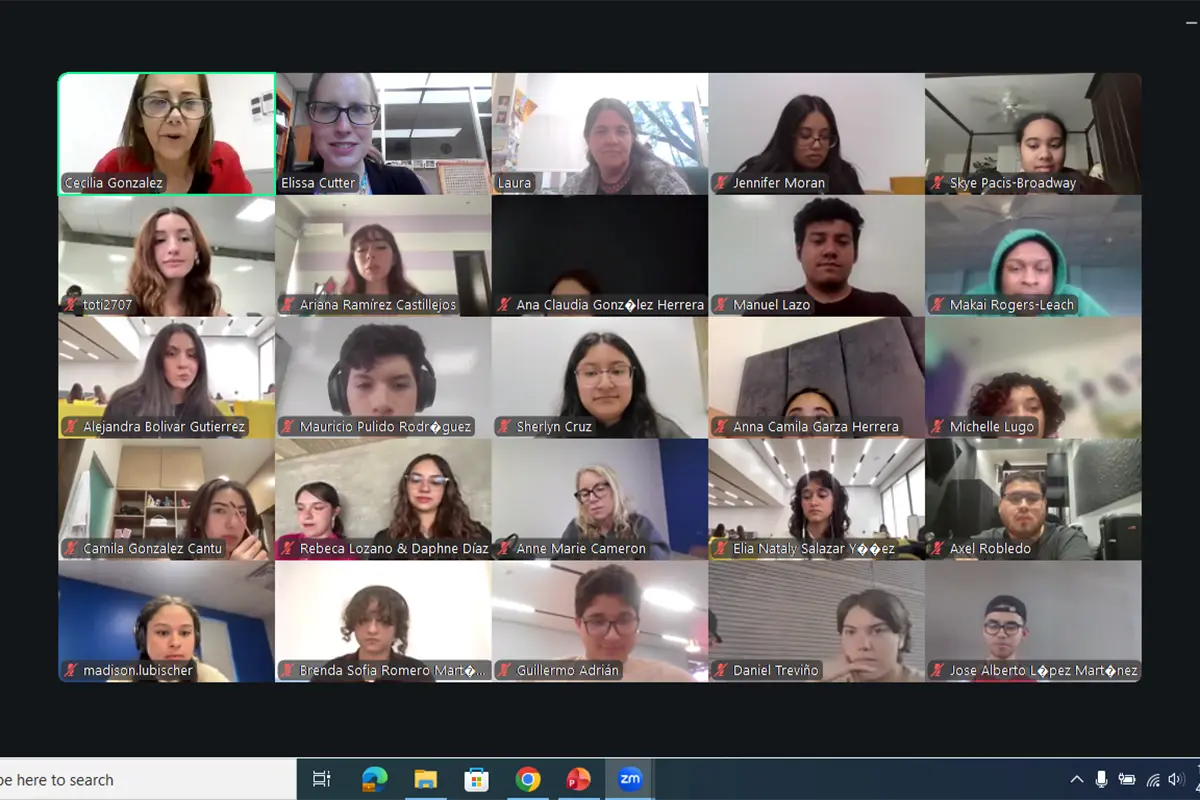
Dr. Elissa Cutter, Associate Professor of Religious Studies and Theology at Georgian Court, partnered with Professor Cecilia Gonzalez Arenas of Universidad de Monterrey in Mexico for the third year in a row. Through a virtual exchange, students in Dr. Cutter’s Social Justice Ethics course collaborated with students in Professor Gonzalez Arenas’ Christian Social Ethics course throughout the semester. The partnership added an international experiential component to a course grounded in Catholic Social Teaching.
“I’ve always felt that the social justice ethics class needed some sort of experiential component,” Dr. Cutter said. “I like this because it broadens the perspective of social justice, to be not just what’s going on in the United States, but to be a global thing.”
Connecting Classrooms Across Borders
The partnership grew from a connection made through Georgian Court’s Office of Global Education Programs. Laura Dunn, Director of Global Education Programs, connected with a colleague of Professor Gonzalez Arenas during a conference workshop on virtual exchange, eventually bringing the two professors together.
Since then, Dr. Cutter and Professor Gonzalez Arenas have continued the collaboration each spring, adapting activities around a different social justice topic.
“Through virtual exchange courses, students enhance their intercultural communication skills as well as their global understanding of other cultures,” Dunn said. “GCU students connect with students in other countries and develop friendships across borders.”
Professor Gonzalez Arenas also sees the experience as an opportunity for students and faculty to learn from one another.
“The value and importance of COIL, Collaborative Online Learning, experience lies on both sides for teachers and students,” she said. “Being able to share ideas, experiences, and deep reflections with students and teachers about topics of global interest creates the challenge to think together for higher purposes.”
For Dr. Cutter, bringing the classrooms together helps students encounter perspectives they might not otherwise experience.
“I felt like it was very good to have the students talking with each other and understanding similarities and differences,” she said. “Especially when they got to know one another, it really broadened their perspectives.”
Exploring Antiracism Through a Global Lens
The collaboration focused on racism, connecting with Georgian Court’s Critical Concerns programming. Students from both universities first came together virtually for shared sessions that introduced the semester’s topic. Dr. Jaime Antonio Rivera Flores, Associate Professor of World Languages and Cultures at Georgian Court, discussed colorism in Mexico, inviting participation from students in both countries.
A second joint session during Critical Concerns Week gave students another opportunity to learn together, ask questions, and participate in a shared conversation about the topic.
Rather than serving as stand-alone lectures, the guest speaker sessions provided a shared foundation for the work students would complete together throughout the semester.
“The point of the speakers, in some way, is to introduce the topic to the students, because then they do a research project with their team,” Dr. Cutter said.
With that foundation in place, the students formed 10 international teams and researched racism in connection with topics including migration, gender, violence, medicine, classism, employment, skin color, law enforcement, climate change, and differences between racism in Mexico and the United States.
Before beginning their research, students recorded introductory videos and explored government, religion, and social structures in their respective countries. Teams later created mind maps based on what they learned from the guest speakers, conducted research, and prepared presentations. Zoom and WhatsApp helped students stay connected throughout the semester.
Learning Through Different Perspectives
For GCU student Madison Lubischer ‘29, a criminal justice major, the course strengthened her understanding of Catholic Social Teaching while introducing an entirely new kind of collaboration.
“We worked on an interesting course project to collaborate with students in Mexico, which I have never done before,” Lubischer said.
Working internationally also required flexibility. “I have learned to also coordinate timing with students in a different time zone,” she said. “Even if there were language barriers, we were still able to understand each other.”
Students at Universidad de Monterrey similarly valued the exchange of ideas.
Rebeca Lozano Villarreal said the experience gave students an opportunity to “discuss different points of view regarding a topic with people from another country.”
Daphne Alejandra Diaz Sandoval said exposure to those different perspectives can challenge students to think beyond the ideas they regularly encounter.
“I think it’s very important to share with other cultures to expand our own knowledge because sometimes when we’re just in our daily lives, we only get to listen to similar opinions,” she said.
At Georgian Court, Skye Pacis-Broadway ‘27, a psychology major, found that the experience changed the way she approached both the course and the world around her.
“Talking about Catholic Social Teaching and why it matters has changed the way that I view the world,” Pacis said. “The collaboration with the students in Mexico let me see other people’s viewpoints, which I greatly appreciate!”
GCU graduate A’Ryah Riddick ‘26, a double major in psychology and criminal justice, also found value in discovering both differences and common ground.
“Working together made me more open-minded to cultural differences,” Riddick said. “It was interesting to see how similar our goals are, even though we come from different backgrounds.”
For Universidad de Monterrey student Patricio Eng Lopez, the experience also reinforced practical skills students will carry beyond the classroom.
“You learn a lot about teamwork. You learn a lot of managing time, and I think it’s very valuable,” Eng Lopez said.
He also described developing “a sense of community” by recognizing that teammates depend on one another.
Together, the students’ experiences showed how the partnership extended beyond studying social justice by encouraging communication, collaboration, flexibility, and openness to different perspectives.
Turning Learning Into Action
The international research was also connected with the “see, judge, act” method of Catholic Social Teaching. For their final papers, Dr. Cutter’s students drew from their collaborative research, evaluated their topics through what they had learned in class, and considered possible responses.
“They had to engage with what they’ve learned in the class in relation to the topic, and think about: what can we do to work for a better world?” Dr. Cutter said.
Students were also encouraged to connect social justice to their future careers and consider how their chosen professions might provide opportunities to make a difference.
The semester concluded with another shared virtual session. Students joined their international teams in Zoom breakout rooms to discuss Bishop Mark Seitz’s pastoral letter Night Will Be No More, bringing together what they had learned about racism, Catholic Social Teaching, and one another throughout the semester.
Growing as Global Citizens
Dr. Cutter and Professor Gonzalez Arenas continue to refine the partnership and build on the relationships created between their classrooms. Professor Gonzalez Arenas hopes the experience encouraged students to recognize that social concerns extend beyond national boundaries.
“As Christians, we are called to make this world a better one, and it all begins in the classrooms with a good idea,” she said.
Virtual exchanges are one way Georgian Court provides students with opportunities to build global perspectives. Faculty members initiate the courses, which can also count toward students’ experiential learning requirements.
“Virtual livestream programs and virtual exchange courses allow students to experience the world and develop intercultural connections,” Dunn said.
For Dr. Cutter, the larger goal is for students to carry that global awareness beyond the semester.
“It’s about not just being a citizen of your own community and your own country, but being ultimately a global citizen,” she said. “The idea that we’re all brothers and sisters to each other.”
Through shared conversations, international research, and relationships built across borders, students at Georgian Court and Universidad de Monterrey gained a deeper understanding of what it meant to learn, collaborate, and contribute as members of a global community.
Learn more about this virtual exchange on the blog here.