Student-led projects explore air pollution, infection prevention, endurance recovery, and mental health
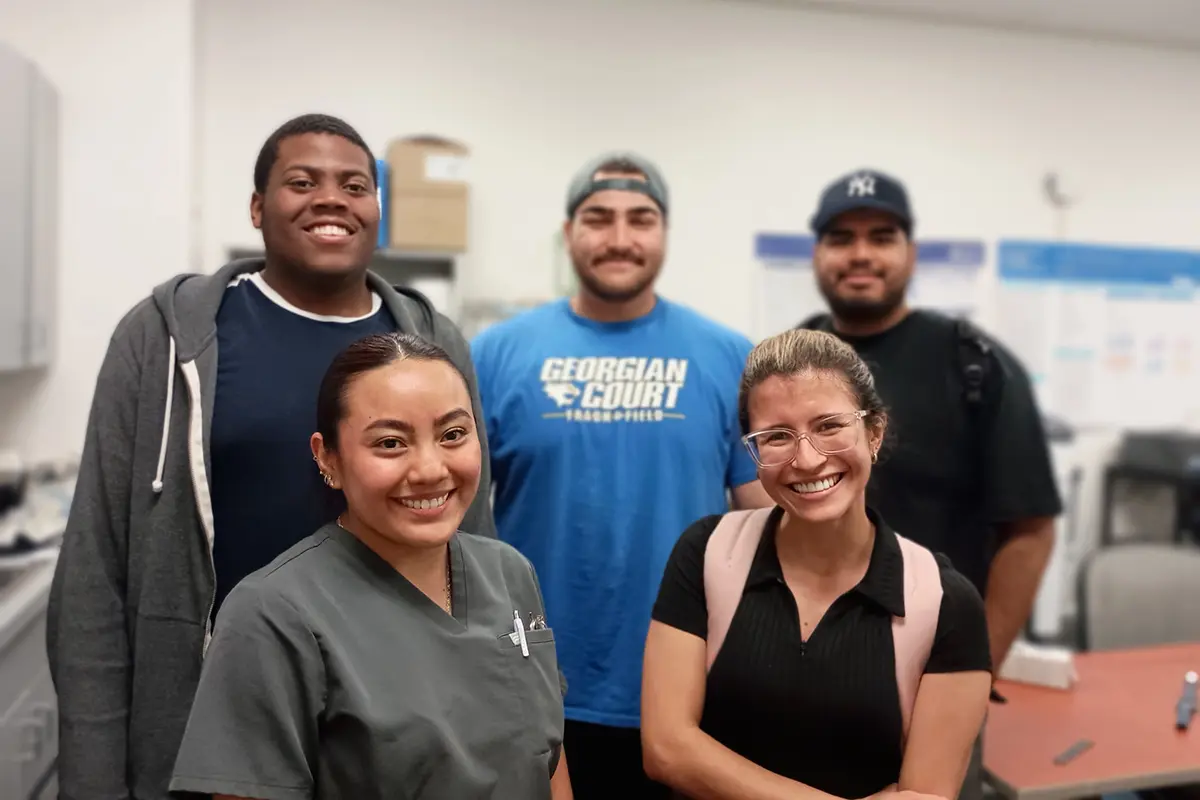
Five Georgian Court University students were selected to receive NASA NJ Space Grants to support their undergraduate research during the 2025–2026 academic year. The grants are part of an annual opportunity that highlights the university’s commitment to hands-on undergraduate STEM research.
Students are awarded paid internships with Georgian Court faculty to conduct research that has implications for NASA, including fundamental research with potential future impact for NASA. Dr. Anne Tabor-Morris annually champions this opportunity to Georgian Court students, encouraging them to explore complex scientific questions through faculty-mentored research. Each awardee received a $2,000 stipend from NASA for projects in their chosen fields, with professors supporting and mentoring the work. All research is being conducted on-site at Georgian Court.
This year’s recipients are pursuing projects in exercise science, computer information systems, biology, and health sciences, with topics ranging from ultramarathon recovery and anxiety interventions to air pollution modeling and antimicrobial resistance.

Colin Bayait, a December 2025 graduate of Georgian Court from Middlesex, New Jersey, researched the physiological and subjective effects of completing a 100-mile trail ultramarathon. His project, “Correlations Between Bioelectrical Impedance and Subjective Measures During Recovery from a 100-Mile Trail Ultramarathon,” examined how the body responds to extreme endurance activity.
Bayait said the opportunity to study such a rare event drew him to the topic.
“The findings are always the most interesting part for me,” he said. “Even if what you thought would happen didn’t happen, it is still an opportunity to learn.”
His faculty mentor, Dr. Vincent Chen, associate professor in Exercise Science and director of the Honors Program, said opportunities like this reflect how students grow through research at Georgian Court.
“Over the years, I have observed students’ learning in the classroom and the lab. Therefore, I can identify students with strong research potential,” Dr. Chen said. “This creates a cycle of learning and growth.”

Darren Burleson, a sophomore from Santa Clarita, California, is researching how machine learning can improve the prediction of Air Quality Index (AQI) categories using structured pollution data. His project, “Prediction of Air-Quality Index Categories using FT-Transformer,” compares advanced models to improve environmental monitoring.
“I was very excited and grateful for the opportunity to be able to participate in something that could have real impact on scientific advancement in the world,” Burleson said.
His faculty mentors, Dr. Sarita Nemani, professor and department chair of Mathematics, Computer Science, and Physics, and Dr. Dae Wook (Wooky) Kim, assistant professor and program director of Computer Information Systems, emphasized the work’s real-world impact.
“The thing that excites us the most is the chance to find an advanced machine learning (ML) technique to solve a real-world environmental problem and deploy a predictive web application using this ML technique,” they said.

Ava Fazzino, a junior from Holmdel, New Jersey, is a dual major in Nursing and Biology with a minor in Chemistry. Her project, “Understanding Bacterial Tolerance to Antiseptics: Chlorhexidine,” examines how Pseudomonas aeruginosa responds to disinfectants commonly used in healthcare.
Fazzino said her experience working in a Medical Cardiac Intensive Care Unit inspired her to explore the science behind infection prevention.
“In simple terms, I’m researching whether the antiseptics we use every day in hospitals are working as well as we expect them to,” she said.
Her faculty mentor, Dr. Jessica A. Lisa, assistant professor of Biology, said the project addresses a critical global issue.
“The topic of antimicrobial resistance both excites and terrifies me,” Lisa said. “What excites me though, is watching students, such as Ava, learn about our antimicrobial crisis in class and become motivated to do something about it.”

Jorge Juarez, a Health Sciences major on the pre-med track from Lakewood, New Jersey, is researching Kanpu Masatsu, a traditional Japanese dry towel massage technique, and its effects on sleep quality and anxiety in college students. His project, “The Effects of Kanpu Masatsu, a Traditional Japanese Massage Technique, on Sleep Quality and Anxiety Levels in Collegiate Adults: A Randomized Controlled Trial,” builds on prior Georgian Court research while expanding its focus to a new population.
“What excites me most is the possibility of contributing new knowledge,” Juarez said. “There is limited research specifically on Kanpu Masatsu, so we are helping build a foundation in this area.”
His faculty mentor, Dr. Vincent Chen, said the research builds on prior work while improving scientific rigor.
“We conducted a project exploring the effects of Kanpu Masatsu on sleep quality with elderly participants, using a sleep-tracking device to obtain unbiased and objective data in the previous school year,” he explained. “This school year, we expanded the project to a younger population.”
Dr. Sachiko Komagata, associate professor and program director of Integrative Health, emphasized the value of student growth through the research process.
“Collaborating with our students on this research has been an extremely rewarding experience,” Dr. Komagata said. “Witnessing our students developing their skills not only in their research itself, but also communicating with the entire research team, solving problems on the spot, disseminating the results with confidence, and reflecting on the meaning and benefits of the research process, is priceless.”

Constantinos Kottas, a senior Computer Information Systems major from Weehawken, New Jersey, is continuing his NASA-supported research with an expanded project, “Seasonal Air Pollution Analysis Using Advanced Machine Learning Clustering Methods.” His work uses clustering algorithms to analyze pollution patterns across U.S. cities over time.
“What excites me most about this research is to be able to discover meaningful insights that could help understand climate trends,” Kottas said.
His faculty mentors, Dr. Sarita Nemani and Dr. Dae Wook (Wooky) Kim, said the project highlights the power of combining environmental science and advanced data analysis.
“The exciting thing about this research is that we can apply advanced techniques of machine learning that enable us to discover new patterns in vast quantities of environmental data,” they said.
Continuing a tradition of undergraduate research
Across disciplines, this year’s NASA NJ Space Grant recipients are tackling real-world challenges in health, environment, and technology. From laboratory investigations to data-driven modeling, these projects both advance scientific understanding and prepare students for future careers in STEM—continuing a growing tradition of research excellence at Georgian Court University.